
What children's imaginary cities reveal about culture
Recently we invited sixteen 5 year olds for a workshop in a kindergarten in Greece. Together we travelled to an imaginary planet. A place with absolutely nothing on it. No buildings, no roads, no parks, and not even a name.
Our question was simple: What do we need in order to live?
The children immediately began imagining their new world. They suggested seeds, water, food, flowers, houses, schools, libraries, hospitals, colours. One child insisted that the planet needed bees “without them there is no life.”
For a moment the conversation sounded less like urban planning and more like a reflection to what makes life possible. Before talking about infrastructure, many of the children spoke about nature. They recognised that people depend on systems that are often overlooked in conversations about cities.
Then it was time to start building. As we looked at the final result, something caught our attention.
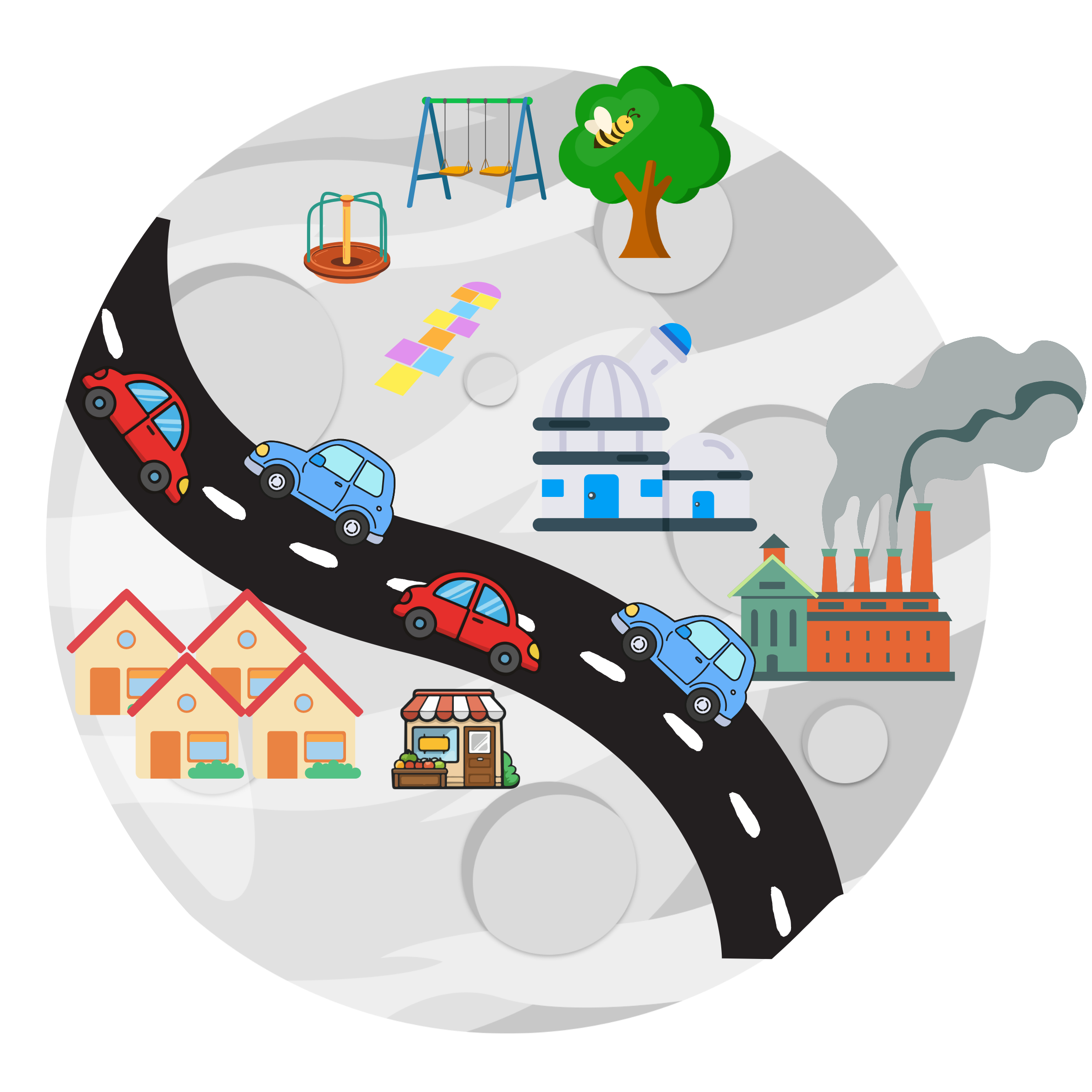
The children had spoken extensively about nature at the beginning of the workshop. Yet the city they created contained roads everywhere and even a factory that produced cars every 30 seconds. At the same time, there were only 2 small bike lanes.
At first this seemed surprising. If nature was so important, why did the final drawing look so car-oriented? The more we reflected on it, the more we realised that perhaps there was no contradiction at all. When we asked children what people need to live, they answered with what they value: water, food, flowers, seeds, bees and places to learn and play. They were thinking about the conditions that make life possible.
But when we asked them to imagine a city, they drew from something different: the world they already know. Their ideas are shaped by the streets they walk on, the journeys they make, and the environments they experience everyday. The roads, cars, and infrastructure that appeared on their planet reflected the reality around them.
In other words, the bees told us what they value, and the roads told us what they have learned to expect.
This is one of the reasons participatory workshops with children are so valuable. They reveal not only what children imagine, but also how culture and everyday experience influence that imagination. The final city was not simply a collection of drawings. It was a snapshot of how a group of young children understand the relationship between people, nature, movement, and urban life.
Children are not urban planners, and the goal of these workshops is not only to produce perfect solutions. The value lies in listening carefully to the perspective they share. Sometimes those perspectives come through direct statements. Sometimes they emerge through a drawing.
That space may tell us more about our cities than we realise.